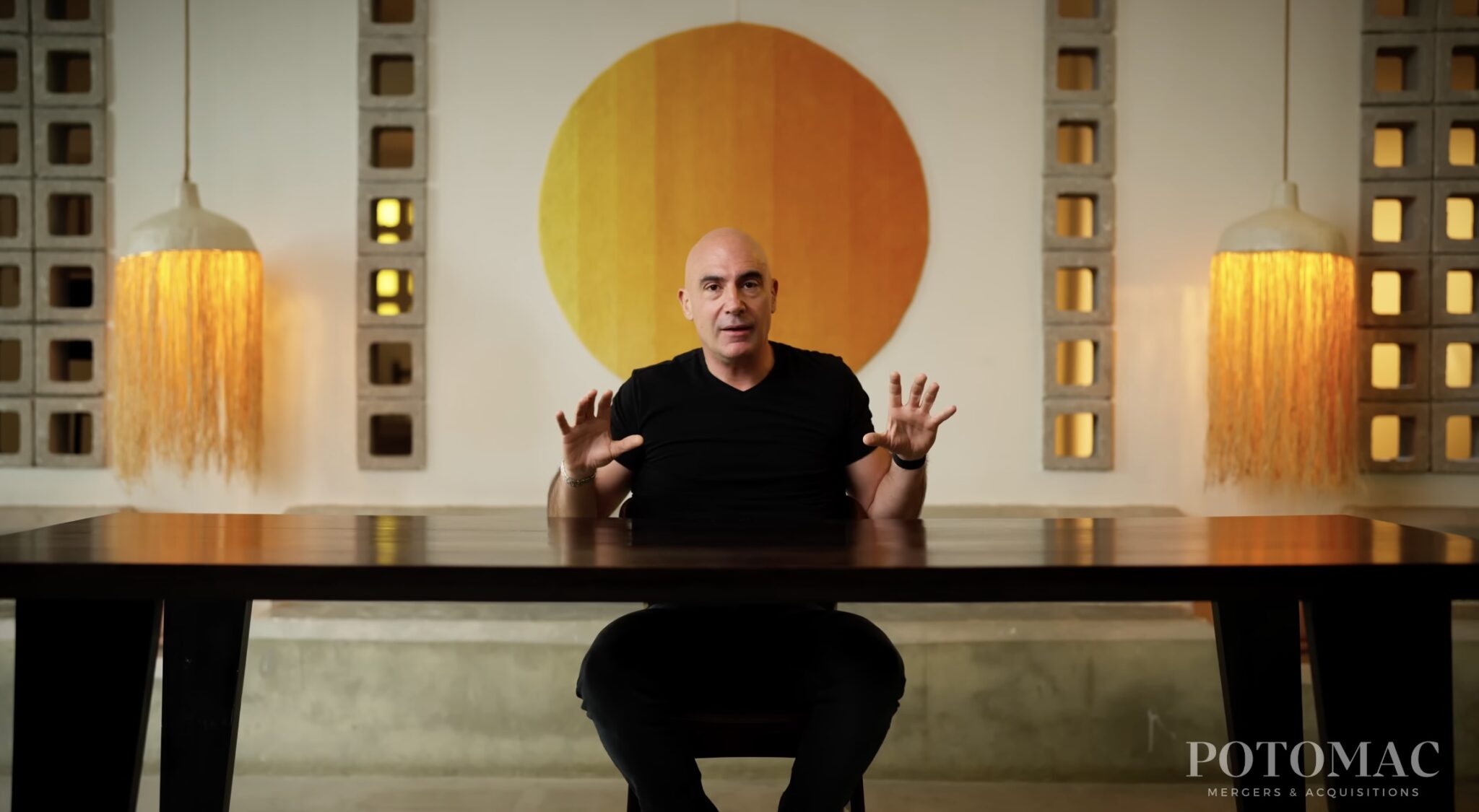



The Education of an Investment Banker, Episode 1: How to Get Hired as a Junior Banker | M&A Masterclass
Today is the first installment of a new series I’m gonna do called The Education of an Investment Banker. And you know, I get a ton of inbounds every single day, scores of them, more than I can even respond to. So I want to use this as the medium for me to get back to everyone who reaches out to me. I’m truly grateful.
I mean, I love the questions, I love the comments. A lot of the questions I get are, how do I get in job investment banking? How does M&A work, what should I do with my life? What’s your favorite color? So on and so forth. So again, I’m gonna use this series to talk to the M&A professional and those aspiring to get into the field.
I’m gonna talk a little bit about my experience over the course of this series, how I got into what I do, how I’ve educated myself, my philosophy on M&A, running the business. And then I’ll also get into probably more detail on the M&A process and things that professionals should be concerned about more so than business owners.
‘Cause the majority of the stuff we do is focused on the business owner as the audience. The first thing I’ll say about investment banking: when I talk about investment banking, I’m primarily talking about M&A advisory, right? Investment banking is broad. You’ve got sales and trading and institutional finance.
You’ve got a variety of different, you know, equity capital markets, debt capital markets. But when I talk about investment banking, I’m usually talking about the small vertical within investment banking, which is M&A advisory, which is where I live. I don’t do any capital raising. I’m not involved in debt securities.
All I do, and all I’ve done for many, many years, is M&A advisory — primarily, or almost exclusively, sell-side M&A advisory. That’s where my skill sets best reside. A lot of my folks on my team make fun of me that I can’t even use an Excel spreadsheet anymore. Now, for many years I was an analyst at a bulge bracket bank and I was an Excel jockey.
But those days, thankfully, are far behind me. But when I think about investment banking, primarily M&A, it’s a craft, right? I mean, it’s not a vocation. It’s very similar to the law. You know, a young lawyer gets out of law school, they pretty much can’t do anything legal-related, right? They have to work under the senior attorneys and learn the ropes.
I mean, they can learn the theory and the case law and so on and so forth in law school, but they probably don’t even know how to really file an actual brief until they get into a law firm and work with mentors or senior attorneys to take them all the way. In a lot of ways, investment banking is the same way, right?
There’s no investment banking school, right? I mean, how — I studied collective bargaining and negotiation at Cornell. I took maybe one or two accounting classes. I think I took one finance class. I couldn’t do any of that when I got into investment banking, and I learned all of that on the job. Now it’s extremely important to have the quantitative and the financial skills, but I started in 1999, and I mean, literally, you know, Goldman Sachs, Credit Suisse, Merrill Lynch was pulling people out of like the Taco Bell drive-through window to work in investment banking, just ’cause it’s a — the dot-com and both things were blowing up.
It was a very different time. But why I mentioned investment banking is a craft, because I think it’s very important to work under somebody who you can learn from and who actually enjoys teaching. I mean, I’ve had some brilliant bosses over the years that weren’t particularly good teachers. And of course, you can learn a lot by just being present, like almost through osmosis and watching what they do.
But then I’ve also had some brilliant bosses who spent time actually teaching us, and the more interest I took in that, the more they were willing to share. And I try to do that in my own practice. I mentioned that because when I think about investment banking in general, again, it’s similar to a law firm, or it’s similar in some ways to the medical profession.
It’s like — when people hire an investment bank, particularly a boutique investment bank, they’re often hiring an individual, right? Just like you go to a law firm — I deal with a bunch of law firms around the world. I’ve got a lot of different law firms that are charging me ridiculous amounts of money.
I’m not really hiring the firm per se. I’m hiring particular lawyers. And so when I think about a lot of the questions that I get about how do you break into investment banking — I mean, I was fortunate. I went to a target school. I graduated, I didn’t even go through recruiting. I went off and did some import-export business for six months and I realized it was gonna be a total bust before I started, or desired, to get into investment banking.
And the way I did it was the way everyone does it. You know, back in those days, email wasn’t as prolific. In 1999 it existed, but we used faxes. I faxed my resume at Merrill Lynch, at Credit Suisse, at Goldman Sachs, and I was faxing my resume left and right. Wasn’t getting any response ’cause it was probably ending in the trash bin.
And then I decided, okay, I need to figure out which investment bankers I wanted to work for — not which investment banks, which investment bankers I wanted to work for. Because at the time, it was the dot-com bubble, and I really wanted to work in the tech space, and Frank Quattrone was working for CSFB out in California, and that’s where I wanted to be.
I wanted to be — you know, this was the tech group to be at. Microsoft, Gateway, Amazon, Netscape, all these things were going on, and Quattrone and Boutros and those guys who were running it. So what I decided to do is, how do I track down Frank Quattrone? Well, that was pretty difficult. But what wasn’t difficult was tracking down one of his administrative assistants.
And Jennifer, if you’re watching this — which I know you’re not — I will always be grateful for your help. You changed the course of my life. So I tracked down and became friends with one of his administrative assistants. Her name was Jennifer. She, in effect, got my CV in front of him, and the rest was history.
I was off to San Francisco and I worked in the tech group, which was a phenomenal experience and really changed the course of my life. But I raised that point because many of you — and I get these, and my colleagues in investment banking — there’s not a day that goes by that we don’t get a resume or a CV via email with the standard cover letter.
Now all of it’s done by ChatGPT, and we get the standard cover letter and the CV. I read these things sometimes — the extreme majority of them I ignore, they go right to our HR people and I never see them. But those that I do see, my question is always like, what’s in it for me? Right? A typical cover letter is usually your accolades.
You know, you went to this school and did that, and you were a cheerleader, football guy, blah, blah, blah. Resume, want a job. And I start to think about, you know, the course of my life and the types of things that helped me the most. And about 20 years ago, I delved really deeply into marketing, advertising, and copywriting.
And I brought some books. Now I have an extensive library both here in Puerto Rico as well as in Switzerland. I’m not as cool as Tai Lopez — no — while I have the books in the garage in front of the Lamborghini and all that, unfortunately that’s not what I have. But I do have an extensive library and I do a lot of reading.
And some years ago I really got into copywriting — not because I wanted to be a copywriter, but because I wanted to understand how copywriters and advertisers think. In fact, when I think about our business, my entire business is basically based on this book in a lot of ways, by David Ogilvy. This is a book, this is a brand-new copy.
I have about 15 copies of this. My main copy is marked up on every single page. I actually don’t know where it is, which is why I brought this one. But in a lot of ways I run Potomac based on the same way David Ogilvy ran Ogilvy and Mather, and I think he is brilliant. One of my virtual mentors. When I think about your job application, you know, it’s like copywriting.
When you write to somebody — whether you’re writing to somebody because you wanna buy his business, or you’re writing to somebody because you want a job — you know, you gotta answer the question, like, what’s in it for them? You always wanna write for the benefit of the reader, and a lot of people write for the benefit of the writer.
So if you’ve recently written a cover letter, maybe you should take a step back and read it and say, okay, whose benefit am I writing for, right? If I answer the question, what’s in it for them, in this letter? Another thing that I learned from the school of copywriting is, always make an offer. Like, always make an offer.
Like, where’s the offer? I get CVs, I get cover letters. I don’t really see offers. Now, you can of course send out tons of resumes all over the place, but again — you know, just an hour ago I filmed a segment of the buy-side M&A masterclass series, and I talked about sourcing transactions.
And I used the example of a guy named Mark who went out and acquired a business from a guy named Jimmy. He did his research up front. He figured out specifically the companies he wanted to target. And he wrote a letter to Jimmy, the business owner, put it in a FedEx envelope, and he wrote the letter to the benefit of Jimmy, not necessarily the benefit of himself, and he made an offer.
So when I think about your CV — like, what are you willing to do? Like, what sort of compensation do you want? Like, what’s your offer? Are you willing to work for — you know, you wanna get in investment banking, are you willing to work for six months for free? I don’t know if you are. You might wanna put that in your cover letter.
So in the same way Mark went out and targeted Jimmy, what I would suggest that you guys do, if you really wanna get in investment banking: don’t worry so much about the bank. Sure, you could say, oh, I wanna work for XYZ investment bank. That’s all well and good. You send your resume to the HR department or the contact form on the website, you literally have a 0% chance of somebody like me actually seeing it.
And if we do see it, it’s almost like a throwaway. It effectively cost you nothing. I mean, nowadays we know that you probably wrote your cover letter on ChatGPT and your resume, right? Like, so literally it was a frictionless, costless transaction for you to send something over. But if you can target people — if you could say, you know what, this investment bank has this particular banker, and actually learn about this individual, right?
Like, okay, you know, nowadays, you know, LinkedIn, Facebook, all sorts of stuff. You can do research on people. You can figure out like where this dude hangs out, what he likes to do, what sort of hobbies he has, what sort of interest he has. And actually write the letter directly to him. And you know what?
No one uses mail anymore. Like, for the love of God, like FedEx something — like you, FedEx something to me. Now, I tend to not always publish a real address online for a variety of reasons, which I’ll get into here, more material. But you can find a mailing address for folks, and you can — prior to email — or FedEx an actual written letter that says, hey, here’s what I’ve done, and here’s what I’ve done.
Here’s what I can do for you. Oh, and here’s some examples of things I’ve actually done with my own mind and hands. Oh, and by the way, here’s some folks that I’ve worked for, and here’s their references, here’s what they have to say about me. If you do that, and you actually attack the individuals that you would like to work for, that you would like for them to be your mentor — half the battle is actually getting in the door.
Half the battle is actually getting it in front of them, and then if you close it with some sort of no-lose offer, I mean, you might have a better chance — actually, you’ve got a definite better chance — of sending it to hr@xyzcompany.com. I think about, you know, writing for the benefit of the reader quite a bit, because it’s in every single one of these books.
And anything that I receive — you know, I would say probably between 40 and 50 LinkedIn messages per day. And again, I love them, and I enjoy the messages that I get. I get a lot of job inquiries. I get a lot of business owners that say they want to talk to us over here at Potomac, and I get a lot from professionals like you.
A lot of job questions. The best way to actually get somebody’s attention — and I’m not just talking, this is not a request from me, but this is anywhere in the business world. Whenever I message a business owner or executive somewhere, I’m always making an offer. I’m always providing value. It’s never about me.
It’s never like, hey, you know, I’m trying to do X, Y, and Z, can I get on the phone with you for 15 minutes to pick your brain? I find that very busy people can do that, but they’re gonna schedule you out two years from now. Because if you look at my schedule, I mean, I travel extensively internationally, and I literally just landed from the Middle East two days ago.
I’m here doing some filming and I’m gonna be on the road again. So busy people don’t really have time to chit-chat about an idea for 15 minutes unless there’s something in it for them. So no matter what we do — whether it’s a job, whether it’s a business proposition — always lead your communication with, by the way, here’s what’s in this for you.
And by the way, here’s what I wanna talk about. So my best advice to those of you who actually want to get in investment banking is to target the bankers that you want to work with. Figure out a proposition, a value proposition for yourself. Put together a nice package and actually get it in their hand.
That would be my advice. Now, there’s folks that go to the opposite end of the spectrum and do some things that probably I wouldn’t do. Last week I was in Asia and one of the YouTube viewers hopped on a plane from London and flew to Puerto Rico. He’s writing a book. He wanted to interview me for a book.
Unfortunately, I flew out of town last minute. It’s not like we had a scheduled meeting. Ducked out on him. I was shocked that he showed up, and one of my colleagues called me — and I was 12 hours ahead — and called me up and said, hey, there’s a guy here, he is looking for you. I appreciate his tenacity. Of course, what he did does sound like something I would’ve done.
As a matter of fact, when I was applying to investment banking, I did hop on a plane and go to London and I interviewed with Lehman Brothers. My point in saying all that is, if you do do something crazy and daring, number one, please make sure that the individual with whom you want to meet is in the country.
That’s probably important. And I don’t know if it’s a really good idea, surprising people per se, but anyway, this fellow took the opportunity to fly across the world to come see me. I missed him. He certainly got my attention, and I’m going to help him, now that I’m back, on what he’s doing with his book. A couple other things I wanna talk about with regard to investment banking jobs.
You know, we live in a world where technology is rapidly replacing the mundane and routine in our business. So in investment banking — you know, when I started, I was an Excel jockey, right? So I would put together financial statements and financial models on Excel and PowerPoints and presentations and all sorts of stuff.
We’re seeing in real time — 2024, 2025, and by sometime in 2026 — it’s very unlikely that there’ll be much human interaction, meaning most of these financial models now can be created by AI. AI can probably put together a better SIM or pitch deck than you can. Make it written better, more coherent, better design.
So all of the things financial analysts have done traditionally at investment banks is disappearing. And so, you know, even over here at Potomac, we have invested extensively. I mean, we have a chief AI architect who works for the firm. I mean, we are really focused on the AI infrastructure. Now I say all of that because —
You know, there are table stakes in the deal world, and the majority of the things that I talk about in my masterclasses are related to negotiation and psychology and advertising and marketing and sales, and so on and so forth. But investment banking — you’ve gotta understand accounting, you’ve gotta understand finance.
You’ve gotta understand how to put together an Excel model. You gotta understand valuation. These are table stakes, and you have to run with those. However, those are not big value-creation levers. So the individuals who really succeed in investment banking over time have two skill sets.
They’re able to sell, so they can bring on clients, and they’re able to solve problems — like, solve their client’s problems. Otherwise, why hire their investment bank to begin with? And I solve one major problem here, which is the sale of a business, right? Getting the highest price and the best terms for our clients.
And I do that by focusing on our core, which is M&A expertise. So over here we don’t do a lot of different things. We focus on our core. It’s like — you know, it’s like if you’ve got a heart problem. I’ll give you a real example. Like, you know, my father had prostate cancer some years ago, and his urologist was like, you know, I’m a urologist, but I’m also a surgeon.
And you know, I worked part-time as a greeter at Walmart — I’m not sure what else he did. And my father was gonna have this prostate removed by this dude who was like a local guy, and I went in there and I asked him, I’m like, how many of these do you do a day? And he’s like, I do one or two a week. Then I went to the University of Chicago and I talked to another guy.
I do three a day and I’ve done it for decades. I’m like, that’s the guy you want, right? The guy who focuses on one thing. He’s not a urologist. He doesn’t care about a bladder infection. He’s not concerned about your kidneys. He is focused on safely and effectively removing that little gland between your legs.
It’s the same thing with what I do. The core of our product is M&A advisory, and we focus on that skill. And I think as a younger person, you know, you gotta get the table stakes in, which is the finance and the accounting and the modeling and so on and so forth. But after that, there’s not many places you can go unless you develop other skill sets.
And within my own firm, I have a very, very heavy focus on psychological training. Because I think that’s very key to understanding the minds of buyers and sellers. We’re focused on — you know, if you’ve watched the masterclasses, you understand the types of things that we focus on over here, and I think those are important to learn.
So over the course of this series — and I’ll continue to do this, as long as I get questions — people often ask me, what books do you read? And today I’m just gonna talk about the copywriting books, but all of these sorts of things have had a dramatic impact on my life. Like, for example — and by the way, I’m not telling you to go out and buy any of these books — like Breakthrough Advertising by Eugene Schwartz.
It took me like two years to read this. I kid you not. There’s actually parts of it I still don’t understand. But one of the most important things that helped me shape the business that we’re in is that, you know, demand in a market can’t be created. It can only be channeled. So advertising channels demand.
And then I started to think about this concept in my own business. It’s like, there’s a lot of businesses out there that can’t be sold, right? It’s just, there’s not enough buyers, or there’s a variety of reasons, but usually there’s no market for that sort of business. And that does exist. That’s not most companies, but that happens.
And so as I began to build this firm, I literally took a playbook, a page right out of this as the playbook, and said, okay, I wanna focus on industries that are actually consolidating, where I’ve got large publicly traded companies, I’ve got private equity firms, and they’re buying a bunch of these middle-market companies.
The demand already existed. I just needed to channel it. So from a copywriting and advertising perspective — I owe a great deal to the now-deceased Eugene Schwartz. This was very helpful to me. This book I love — Drayton Bird. Sales Letters That Sell. Now, Drayton talks a lot about the same sorts of things I just said to you. Like, for example, a quick passage.
Like most things designed to sell, they suffer from one big fault. They’re written from the point of view of the writers, who believe everybody should be interested in them or what they want to sell, rather than the readers, who have the identical feeling, but from the opposite perspective. So there can be a lot to be learned from guys like Drayton Bird.
I’m not gonna go through all of these. Claude Hopkins. You know, if you watch the masterclass series, a lot of folks talk about my storytelling. It comes from this — My Life in Advertising. It’s Scientific Advertising. Our friend here, David Ogilvy, who ran Ogilvy and Mather, said that in order to work for him, you needed to read this book seven times.
So I took his advice and I’ve read it that many times. I’ll skip the rest of these books. I’m not gonna get too into advertising copywriting, but what I am saying is, like, from my perspective, everything that I try to do, I try to provide value for the recipient. Whether it’s the audience, you know, our audience, right?
What I’m trying to do on this YouTube channel is say, okay, I’m here. I wanna make very educational videos. I want to educate business owners so they can understand the mechanics of an M&A transaction, the psychology of the deal. And I want them to be able to understand private equity and valuation and so on and so forth.
And I do that. And of course, at the end, I pitch my services, because I’m not running a charity. But my main priority is to get out there and teach. And I think a lot of the reasons why I do that — and I do that within our firm, and I speak in different places — but I think a lot of the reasons why I teach is that it really helps me clarify thought.
So if I have to get on here and speak with you, I don’t wanna just come up here like a bumbling idiot. And I don’t use teleprompters or notes or scripts or anything like that. But I think about what I wanna say and I try to organize my thoughts, and it kind of helps me refine my philosophy on psychology and negotiation and M&A.
So it’s been beneficial to me personally, and I hope also it’s beneficial to you. Now, I’ll continue with this series as long as I get great questions. In a perfect world, you’ll put your questions here on YouTube, because my team — who’s more competent than me and disciplined, by the way — will be able to pull down the comments and I will attempt to answer your questions.
Alternatively, you can join me on LinkedIn. That link is below in the description. You can send me a message. It’s going to be slower, it’s going to be less reliable, but eventually I — my assistant — may get to that. Again, I’m Paul Giannamore. Thank you for joining me. See you on the next one.
The Education of an Investment Banker: How M&A Advisory Is a Craft, Not a Career Path
In the first episode of his Education of an Investment Banker series, Paul Giannamore — founder of Potomac M&A and a veteran sell-side advisor — breaks down what it actually takes to build a career in investment banking, why AI is eliminating the traditional analyst role, and what both aspiring bankers and business owners can learn from the world’s greatest copywriters.
Investment Banking Is a Craft Learned Through Mentorship
Paul draws a direct parallel between investment banking and the law: just as a law school graduate can’t walk into a courtroom and try a case alone, a newly minted finance graduate isn’t ready to run an M&A transaction. The real education happens under senior practitioners. Paul credits much of his own development to bosses who were not just brilliant, but genuinely willing to teach — and he carries that same commitment into his own firm at Potomac.
Target the Banker, Not the Bank
One of Paul’s most actionable pieces of advice for anyone trying to break into investment banking: stop sending your resume to hr@xyzcompany.com. Instead, identify the specific bankers you want to learn from, research them, and get something physical — a FedEx package, a handwritten letter — directly into their hands. Paul traces his own entry into the industry back to exactly this approach, tracking down an assistant to Frank Quattrone at CSFB and landing a seat in the tech group during the height of the dot-com boom.
Write for the Reader, Not Yourself — and Always Make an Offer
Drawing on decades of study in advertising and copywriting — David Ogilvy, Eugene Schwartz, Claude Hopkins, Drayton Bird — Paul argues that most cover letters fail for the same reason most bad ads fail: they’re written for the benefit of the writer, not the reader. A strong outreach, whether a job application or a deal approach, answers one question first: what’s in it for them? And it always closes with a concrete offer — even if that offer is six months of work for free.
AI Is Replacing the Analyst — Here’s What That Means for Your Career
The traditional investment banking analyst role — financial modeling, CIM preparation, pitch decks — is being automated. Paul is candid: by 2026, most of what junior bankers have historically done will be handled by AI. Potomac itself has invested heavily in AI infrastructure, including a dedicated chief AI architect. The takeaway for aspiring bankers isn’t to abandon the technical fundamentals — those remain table stakes — but to understand that the real value-creation levers are sales ability and problem-solving, not spreadsheet fluency.
Focus Is the Competitive Advantage
Paul explains why Potomac focuses exclusively on sell-side M&A advisory rather than offering a broad suite of financial services. Using the analogy of a surgeon who performs three prostatectomies a day versus one who does one or two a week, he makes the case that deep specialization — not breadth — is what clients are actually paying for. The same logic applies to anyone building a career in the field: develop a genuine area of mastery rather than spreading thin across every corner of finance.
The Books Behind the Philosophy
Paul references several books that have shaped how he thinks about client communication, deal sourcing, and firm-building: Ogilvy on Advertising by David Ogilvy, Breakthrough Advertising by Eugene Schwartz, Sales Letters That Sell by Drayton Bird, and My Life in Advertising / Scientific Advertising by Claude Hopkins. He doesn’t recommend buying them as a checklist — he recommends studying them the way Ogilvy did: repeatedly, until the principles become instinct.
Frequently Asked Questions
Is investment banking something you can learn in school?
Not really. Investment banking — particularly M&A advisory — is a craft learned on the job under experienced practitioners, much like the law or medicine. Schools can teach theory, accounting, and finance fundamentals, but the real education happens through mentorship and hands-on deal work.
What is the best way to break into investment banking?
Rather than sending a resume to a firm’s HR department, identify the specific bankers you want to learn from and reach out to them directly. Research the individual, write a letter focused on what you can offer them — not just your credentials — and deliver it in a way that stands out, such as a physical FedEx package. Always close with a concrete offer.
What should a cover letter for an investment banking job include?
A strong investment banking cover letter should be written for the benefit of the reader, not the writer. Lead with what you can offer the banker or firm — not just your academic or professional accolades. Include a concrete offer, such as a willingness to work on a trial basis, along with specific examples of work you have done and references who can speak to it.
Is AI replacing investment banking analysts?
Yes, the traditional junior analyst role in investment banking is being significantly disrupted by AI. Financial modeling, CIM preparation, and pitch deck creation — tasks that once defined the analyst role — are increasingly being handled by AI tools. By 2026, most of these functions are expected to require little human involvement. Aspiring bankers should focus on developing sales ability and problem-solving skills, which AI cannot replicate.
What skills do you need to succeed long-term in investment banking?
Technical skills like financial modeling, valuation, and accounting are table stakes — necessary but not differentiating. The bankers who build lasting careers are those who can sell (bring in clients) and solve complex client problems. Psychological insight, negotiation ability, and deep industry specialization are the real value-creation levers.
What is sell-side M&A advisory?
Sell-side M&A advisory is the work an investment banker does on behalf of a business owner who wants to sell their company. The advisor manages the entire sale process — from preparing marketing materials and identifying buyers, to negotiating terms — with the goal of achieving the highest price and best deal structure for the seller.
Why should a business owner hire a boutique investment bank instead of a large firm?
When hiring a boutique investment bank, you are often hiring a specific individual and their expertise — not just a brand name. Boutique advisors who specialize exclusively in a particular type of transaction, such as sell-side M&A in a specific industry, tend to bring deeper knowledge and more focused attention than generalist bankers at large firms.
How does industry focus affect M&A outcomes?
Advisors who specialize in consolidating industries — where strategic buyers and private equity firms are actively acquiring — can channel existing buyer demand rather than trying to create it from scratch. This focus typically results in a more competitive sale process and better outcomes for the seller.
What books does Paul Giannamore recommend for investment bankers?
Paul recommends studying copywriting and advertising classics to sharpen communication and client development skills: Ogilvy on Advertising by David Ogilvy, Breakthrough Advertising by Eugene Schwartz, Sales Letters That Sell by Drayton Bird, and My Life in Advertising and Scientific Advertising by Claude Hopkins. He credits these books with shaping how he approaches outreach, deal sourcing, and firm-building.
What does “always make an offer” mean in the context of a job application or deal outreach?
Borrowed from direct-response copywriting, “always make an offer” means every outreach — whether a job application or a letter to a business owner — should include a clear, specific proposition for the recipient. For a job seeker, that might mean offering to work on a trial basis. For a buyer approaching a business owner, it means presenting a compelling reason to have a conversation. Vague expressions of interest get ignored; concrete offers get responses.