
The Dream of the Entrepreneur: Falconry and a Gift from Prince Charles | John Dickson
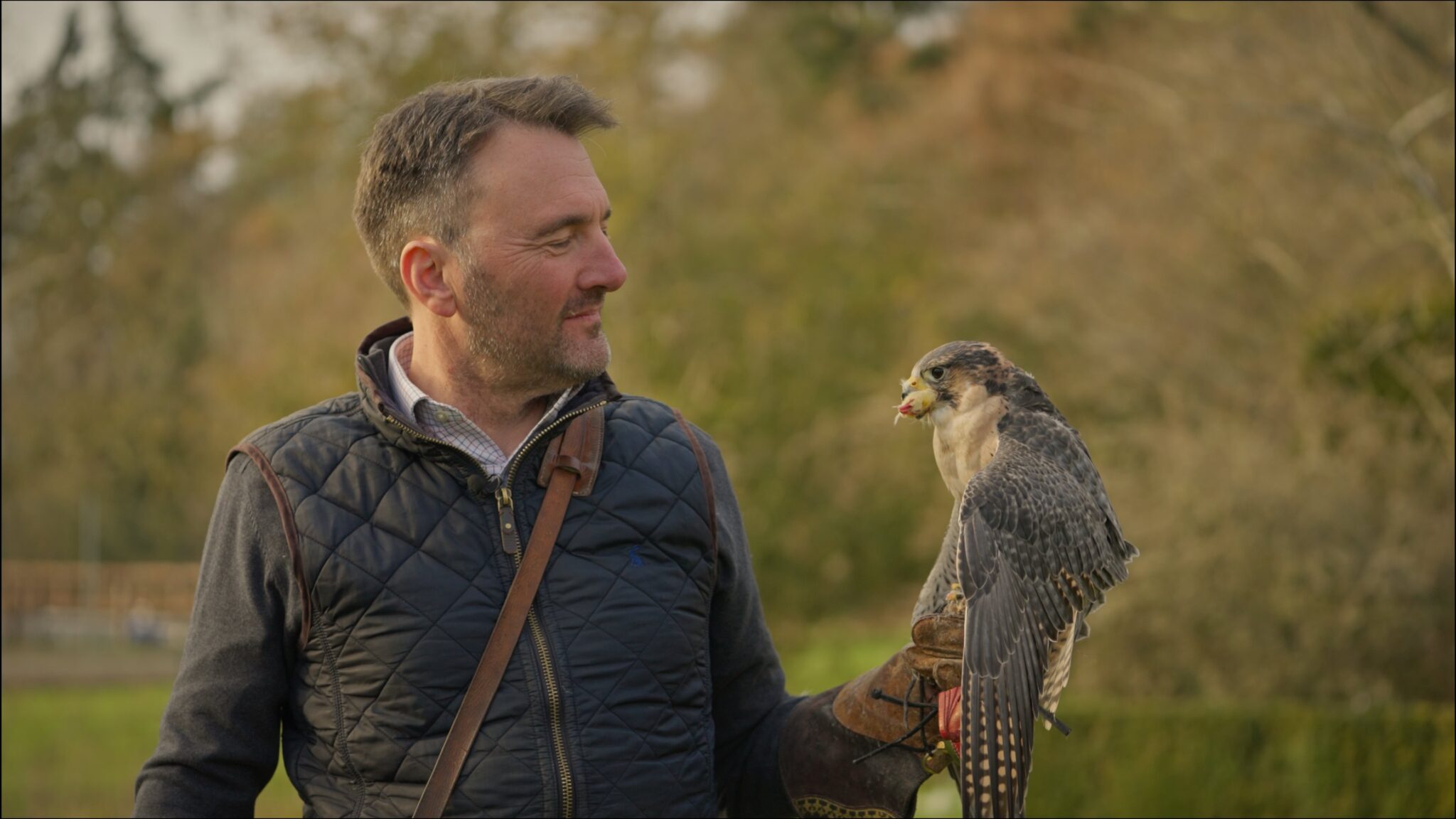
We left London early on an overcast Saturday morning to head out to the English countryside to visit John Dixon, the former owner of NBC Environment and one of the largest privately held pest control companies in the United Kingdom. My producer Dylan decided this was a great opportunity to attempt to drive on the wrong side of the road — but we made it out there in one piece. We got to visit John’s 16th century manor estate, and for the first time in my life, I was able to get up close and personal with a falcon.
It took a long search before finding the property — nearly 20 houses looked at before the right one came along. The problem was that houses were either in poor condition and needed a lot of work, or they simply didn’t have the land. This one ticked so many boxes. The gable ends are Elizabethan — some parts nearly 500 years old — with elements on the site dating all the way back to the 13th century.
The moat, built around 1900 at the same time as the outside of the house, sits quiet and muddy in the winter months — but come summer, it’s a different picture entirely. It’s the kind of place that reveals itself slowly, and for a family that came to look at it in the summer, the excitement about what it will become is very much alive. Country living comes with its hazards, though — including the occasional tumble while digging out the moat.
His daughters have taken to the estate naturally. One is devoted to her horses, while the other channels her energy into running, biking, swimming, and triathlons. Horses, as any owner will tell you, are not a casual commitment. They’re almost always nursing some injury, they rarely travel alone — one horse tends to become two — and they require daily attention. Cars, by contrast, sit quietly in the garage under a dust sheet and don’t bite.
NBC turned out to be a remarkable story — thirty years of hard work building something from the ground up. The entrepreneurial drive behind it is something he’s candid about: the definition of success is never fixed. Every milestone simply moves the goalposts further out. It’s the kind of restlessness that drives a spouse mad and propels a business forward at the same time.
The story behind NBC begins not in a boardroom, but with a book. At thirteen years old, a novel called Kes — later adapted into a film — sparked a fascination with falcons. Trips to the zoo deepened the interest, and by chance, a family connection led to someone who rescued birds and passed them along to a young enthusiast. The birds were expensive; the passion was free.
His family’s business was in furniture, so he tried that route first, setting up his own furniture company at around nineteen. Predictably, it didn’t last — a young man in his early twenties isn’t always as focused as a business demands. But then came the turning point: a letter to an environmental consultant looking for work, and an offhand remark in response. The consultant noticed falconry on the CV and mentioned a nearby site that might need bird control services. It was a Eureka moment. Sales skills met an untapped opportunity, two contracts were won, and NBC was born.
What made it work early on was momentum — and the fact that most people in the bird control world were falconers first and businesspeople second. He came at it the other way around. The business grew quickly as a result.
Firecracker — one of the birds on the estate — is a perfect example of what people misunderstand about falcons. Fully grown, they simply like to sit and rest before they fly. These are working birds, not sporting birds. Their job is to scare, not necessarily to catch — though the threat is entirely real. Unlike mechanical bird-scaring devices that lose their effect over time through habituation, falcons never stop working. If a bird doesn’t fly away, it simply becomes dinner. That’s the logic that keeps the system honest.
The falconer’s skill lies in training the birds to work positively — rewarding them when they chase, so they begin to understand that chasing is the job. Over time, a falcon will define its own territory and defend it instinctively, keeping an area clear of unwanted birds indefinitely.
What sets NBC apart is its use of falcons rather than hawks. Most bird control companies rely on hawks because they’re easier to handle, but the difference in capability is significant — comparable to an F1 car versus a hot hatch. A single falcon can clear an entire airfield, a mile or more across. Put one bird on a landfill site with three thousand seagulls, and every one of them will leave. Hawks, by contrast, hunt by surprise and cover far less ground. For large-scale, sustained bird management, falcons are in a different league entirely.
NBC employs around 60 falconers, most of whom are also cross-skilled in general pest control. New recruits come in with no experience — just this week, three went through training — but the passion has to be there. These birds go home with their handlers. They’re a round-the-clock responsibility, not a nine-to-five one.
Building the business without capital was simply a matter of necessity. There was no family money to draw on, no safety net — just a lack of major responsibilities that made the risk feel possible. Support from the Prince’s Trust helped in the early days, and in 1994 or 1995, the Prince of Wales presented a Young Entrepreneur of the Year award that marked how far things had come.
The journey from two bird control contracts to a national pest control company with roughly a 50/50 split between bird management and traditional pest control is one that grew organically. NBC remains the largest employer of falconers in Europe — a distinction that still catches people off guard when they hear the name.
The decision to sell came almost by accident. The business was on a strong trajectory, but the post-COVID growth had always felt artificial — the kind of run that couldn’t last indefinitely. A passing comment from the finance director about his own exit plans was enough to prompt a wider look at the landscape. Reading the Supernova blog crystallized what was already forming in the background: the acquisition market in the UK was strong, competition was intense, and the economic outlook was uncertain. A conversation followed, and the process began.
The sale to Rollins wasn’t just about the exit. NBC had always been about its people — the ones who built it and made it what it was. Continuing that growth, giving those people the platform they deserved, meant finding a partner who could take the business further than it could go alone. In Rollins, that fit was found.
What a lovely day spent out in the English countryside — watching the falcons soar into the grey winter sky, walking the grounds of a 16th century estate, and hearing the story of a business built on passion, instinct, and thirty years of relentless forward motion. As the sun began to set and the drive back to London began, the reminder was a simple one: a beautiful life really can exist outside of work, and the dream of starting from nothing and building something extraordinary is very much alive and well.